
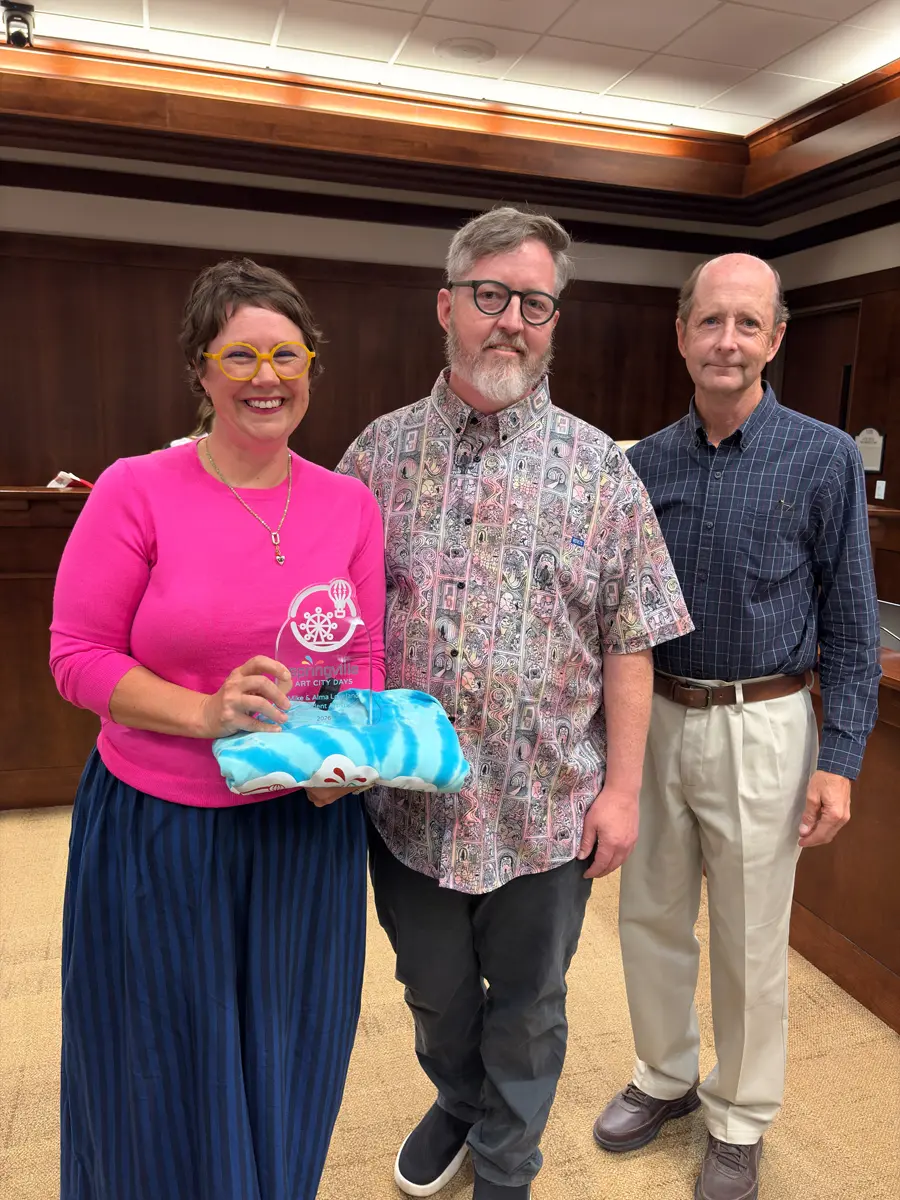
Dr. Vern G. Swanson, former director of the Springville Museum of Art, has been selected to be honored as Springville’s 2025 Art City Days Resident Artist.
Vern was born in the small saw-mill and orchard town of Central Point in southern Oregon in February 1945 to working-class parents, Oscar and Mildred. The youngest of six children, he became interested in art by the second grade. At the age of 14, he joined The Church of Jesus Christ of Latter-day Saints, the first of his family to do so. In autumn of 1964, he attended Brigham Young University in Provo on a football scholarship, studying fine art painting and art history.
Vern had never been to Utah before, but his undying attachment to the Springville area began even before school commenced that fall. He heard there was an art museum in Springville, and since football was to begin the next day, he took the opportunity to hitch-hike there. Without another thought, off he went, and his life would never be the same. He ended up running most of the way on that hot and dry August day. He had done this in Oregon where the air had moisture and oxygen plentiful. He ran past a bank in downtown Springville that had a clock that said one minute to 5 p.m.
Vern asked people where the art museum was, and they keep saying gibberish like “400 South 126 East” — what did that mean? He finally made it to the museum just as Julie Snow-Berkheimer was locking up. Out of breath, he ran up to her and begged to go in, but she had errands to run and couldn’t reopen the doors. “I remember going to the ground, sweating profusely and obviously suffering begging for water,” he said. She could see that he was in trouble and broke down and let him in. And with that, the world would change for both of them.
She took him to the drinking fountain and he looked left into the step-down gallery, now renamed the Swanson Gallery. He saw statues of a buffalo and a nude Lady Godiva on horseback and exclaimed, “That’s an Avard Fairbanks and that’s an Anna Hyatt Huntington!” With that, they went carefully through each gallery, giving a tour to each other. Before he left, they sat on a wooden bench contemplating what had just spontaneously happened. She slapped him on his knee and said, “One day you will become the curator of this gallery.” And, 16 years later, on Aug. 1 of 1980, her prophecy came true.
Upon graduating from BYU in 1969, he moved to Washington, D.C., where he worked at the National Gallery of Art for a year as a museum aide supervisor in charge of their museum store. Swanson returned to Utah, ostensibly to find a wife and to take a position running an art sales gallery first in Salt Lake City, then in Provo. There, he met Elaine Milne, a BYU student from Alberta, Canada, and they married in the Cardston Alberta Temple. He later worked for almost a year at an art sales gallery on Sutter Street in San Francisco. He then moved to Calgary, Alberta, where Vern worked construction for his father-in-law and coached semi-pro football. After a year, they returned to Salt Lake City, where he began a master’s degree program in art history at the University of Utah, working under Dr. Robert S. Olpin.
After graduation in 1973, he was hired by Auburn University in Alabama as an assistant professor of art and art history. After the tragic deaths of his wife and young son in April of 1975 in an automobile accident, he taught for another year. Returning to Utah in the summer of 1976, he met Judy Nielson of Lynndyl, Utah, at a special interest dance at BYU, fell in love again and married that December in Manti. They now have two daughters, Amber Swanson Mendenhall and Angela Swanson Jones, and five grandchildren.
Vern worked at Wasatch Bronzeworks foundry in Lehi for two years, then enrolled at the Courtauld Institute of Art, University of London, in England in 1978 and “three terms later” received his Ph.D. in art history. Dr. Swanson has since authored and co-authored 23 books. He was twice given the Utah Governor’s Award for the Arts. From 1989 to 2007, he consulted for a Minneapolis client and brought 24,000 Russian works of art to America and also built the SMA’s Russian art collection.
The Springville Museum of Art hired him to be its director in August of 1980, where he served with distinction for 32 years before retiring in August of 2012. During his tenure, he helped articulate the museum’s mission/vision, supporting objectives and standards. He quadrupled the size of the permanent art collection (mostly of Utah and Soviet realist art), doubled the size of the facilities with a new wing and sculpture garden, and increased the staff and overall professionalism. Being its director was one of the greatest honors of his life.
In 2012, he retired to write books on art, theology and politics and to be with his family as much as possible. He continues to volunteer at the Springville Museum of Art and to consult for the world’s major auction houses and 19th century European and Soviet art collectors. He loves to work with his church (The Church of Jesus Christ of Latter-day Saints), travel with family and friends, work with his fruit trees and, of course, watch BYU football.